How to explain Secret Santa to kids
Explain Secret Santa to kids in one sentence, choose between receiving only and giving with help, keep the secret together and write their wishlist.
Written and checked by Francisco T. Barbosa on October 16, 2026.
Secret Santa in one sentence a child understands
To explain Secret Santa to kids, use one sentence: everyone in the family gets one surprise present, and the person who gives it keeps their name a secret. Then add your child’s own part. Leave the budget and the rules to the adults.
For a child who only receives: ‘Someone in our family is getting a surprise ready, just for you.’ For a child who gives with your help: ‘We’re making a surprise for one person, and someone else is making one for you. Nobody says who.’
The name can confuse a young child: Secret Santa is not Santa Claus but someone in the family keeping a secret. If your child believes in him, call it a family game, with one present from one person.
In SantaTogether, children never sign in or need an email address. The adult who looks after a child adds them as a profile and opens any match for them, so there is no slip of paper to lose. To start, create a family exchange.
Receive only or give with help: which suits your child
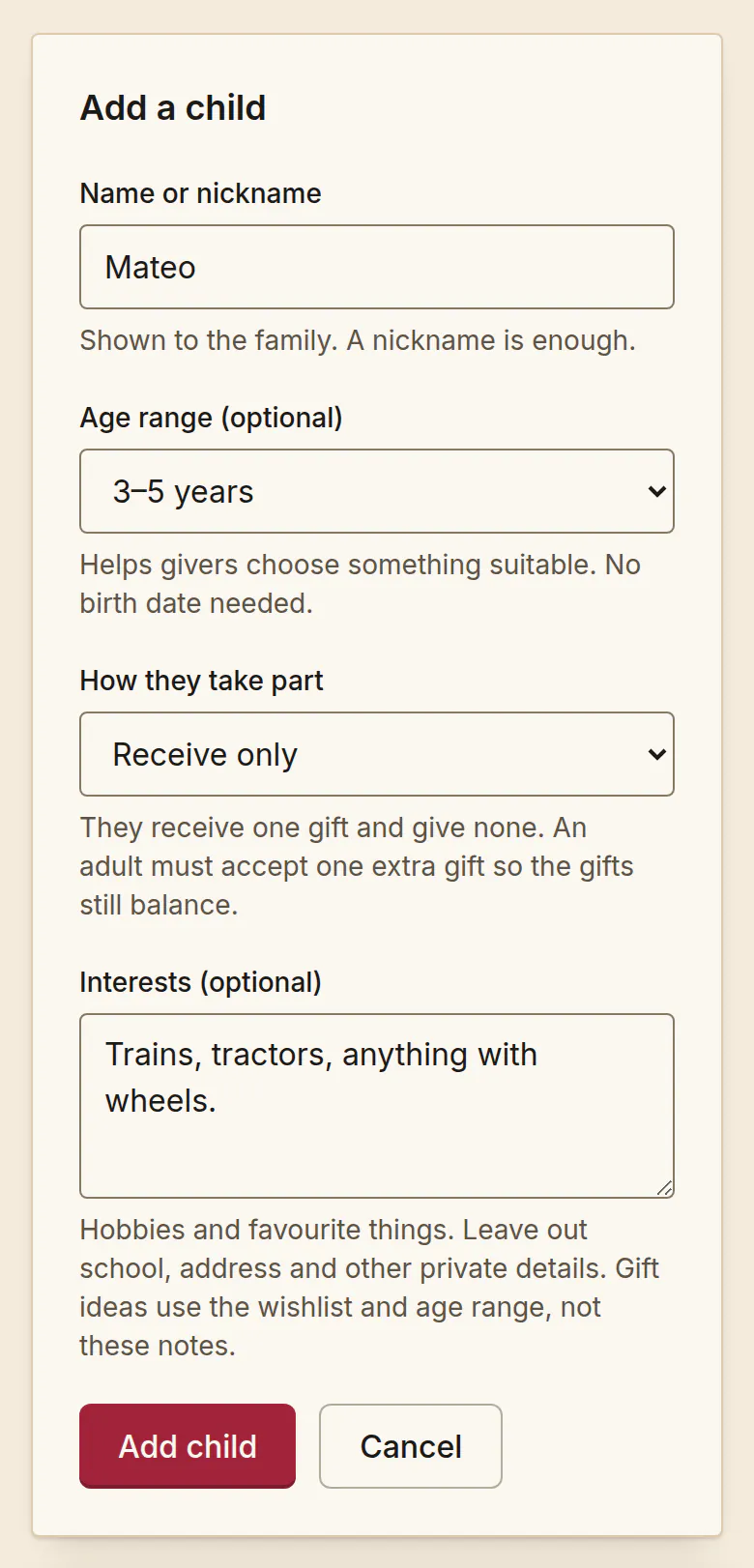
When you add a child, the app asks how they take part. With ‘Receive only’, they get one gift and give none. An adult must accept one extra gift before the draw, and nobody is given one automatically. With ‘Give and receive, with my help’, they get one gift and give one. You help choose and buy it, and only you see who they give to.
The app sets no age rule, so go by your child. In a fictional family, Hannah adds Ruby, 4, with ‘Receive only’, and Ruby’s aunt Grace accepts the extra gift; the draw decides who receives it. Freddie, 7, likes choosing and wrapping, so he gives with Hannah’s help. Grace’s partner Omar joins too, so three adults and two children take part.
Hannah pays for the present Freddie gives, at the same budget per gift as every other present. The app shows it on his row, not in her own total. The choice can change until names are drawn.
By default, nobody draws someone from their own household, meaning a parent and the children they manage. So Freddie will not draw Hannah or Ruby. The organizer can change this before the draw. Your partner is a separate household; the organizer can add an exclusion if they should not draw your child.
Helping a child keep the secret
A child who only receives has no name to hide. Their giver is hidden from you too. You see only the matches you and your children give, and the household rule, on by default, keeps those away from your own children.
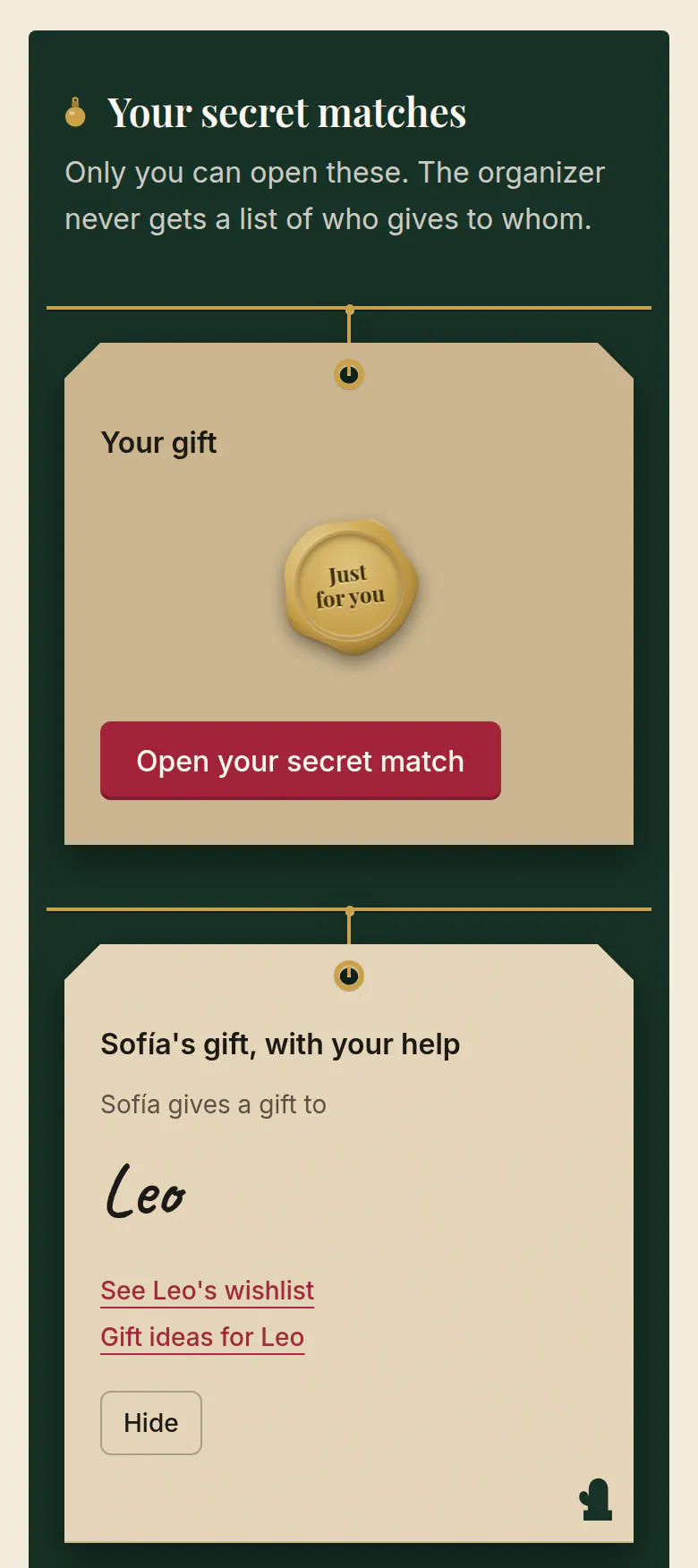
Freddie’s match sits on its own tag, ‘Freddie’s gift, with your help’, which only Hannah can open. The name appears when she opens it, and Hide covers it again, which helps on a shared tablet. The organizer cannot see it, so there is no list for a child to find.
Decide when your child hears the name: on the day you shop, or once the present is wrapped. Give them a ready answer to ‘Who did you get?’, such as ‘It’s a secret until gift day’, and practise it together.
When SantaTogether emails adults that names are drawn, the email never names a recipient. If your child tells someone anyway, keep it light: if one person knows, they can keep it to themselves, and nothing in the app needs to change.
Choosing and wrapping a gift together
When you are ready to shop, open the tag and follow the link to the recipient’s wishlist, which shows the budget per gift. Pick two or three ideas that fit, and let your child choose one.
If the recipient welcomes handmade gifts, your child can make part of the present, such as a card. Let them wrap it and decorate the tag. Write ‘From your Secret Santa’ on it yourself if their handwriting would give them away.
You pay, so your child needs no money of their own. For a younger recipient, check the age guidance. SantaTogether does not collect addresses or send gifts, so agree delivery with the other adults, or let your child hand the present over on the day.
Writing a wishlist with a child (the kids’ questionnaire)
Start on paper with the kids’ questionnaire, a free printable PDF in A4 or US Letter, with no sign-up. It asks for favourite things, what your child already has lots of and any allergies. In the PDF, its 12 tick boxes have small drawings, and there is space to draw a present.
Fill it in together before the draw; a child who cannot write yet can point, tick and draw. Then type the answers into your child’s wishlist in the app, one idea per item, with a note for a size or a colour.
Only you and, after the draw, the adult handling your child’s present can read that list. Leave out the school, the address and contact details. You can edit it after the draw, but the giver may already have bought something.
Tell your child the list gives ideas and the giver chooses, so the present they drew on the sheet is a hint, not a promise.
When a child is disappointed
Before the day, remind your child that everyone gets one present at the same budget, chosen by the giver.
Practise a thank-you in advance. If your child is upset when they open their present, give them a moment away from the table, and talk about it later, in private.
Afterwards, help them thank their Secret Santa with a drawing or a message in the family chat. If they only received this year and wanted to give, they can give with help next year.
Frequently asked questions
- How do you explain Secret Santa to a child?
- In one sentence: everyone in the family gets one surprise present, and the giver keeps their name a secret. Then explain your child’s own part.
- Should my child give a gift or only receive?
- Go by your child. With ‘Receive only’, an adult accepts an extra gift; with ‘Give and receive, with my help’, you help with the present they give.
- Can the organizer see who my child gives to?
- No. Only the adult who looks after a child can open the child’s match.
- What if my child tells someone who they are giving to?
- Keep it light. If one person knows, they can keep it to themselves, and nothing in the app needs to change.
- What if my child is disappointed with their present?
- Prepare them: everyone gets one present at the same budget. Practise a thank-you, and talk about it later, in private.
Put the plan into practice
Invite the adults, include children through a parent, and agree the gifts before drawing. Core exchanges and wishlists are free.