Secret Santa exclusions: couples, children and impossible draws
Set partner and household exclusions, see why balanced gifts can still leave an impossible draw, and work through a family example that can be repaired.
Written and checked by Francisco T. Barbosa on October 9, 2026.
Explain an exclusion in both directions
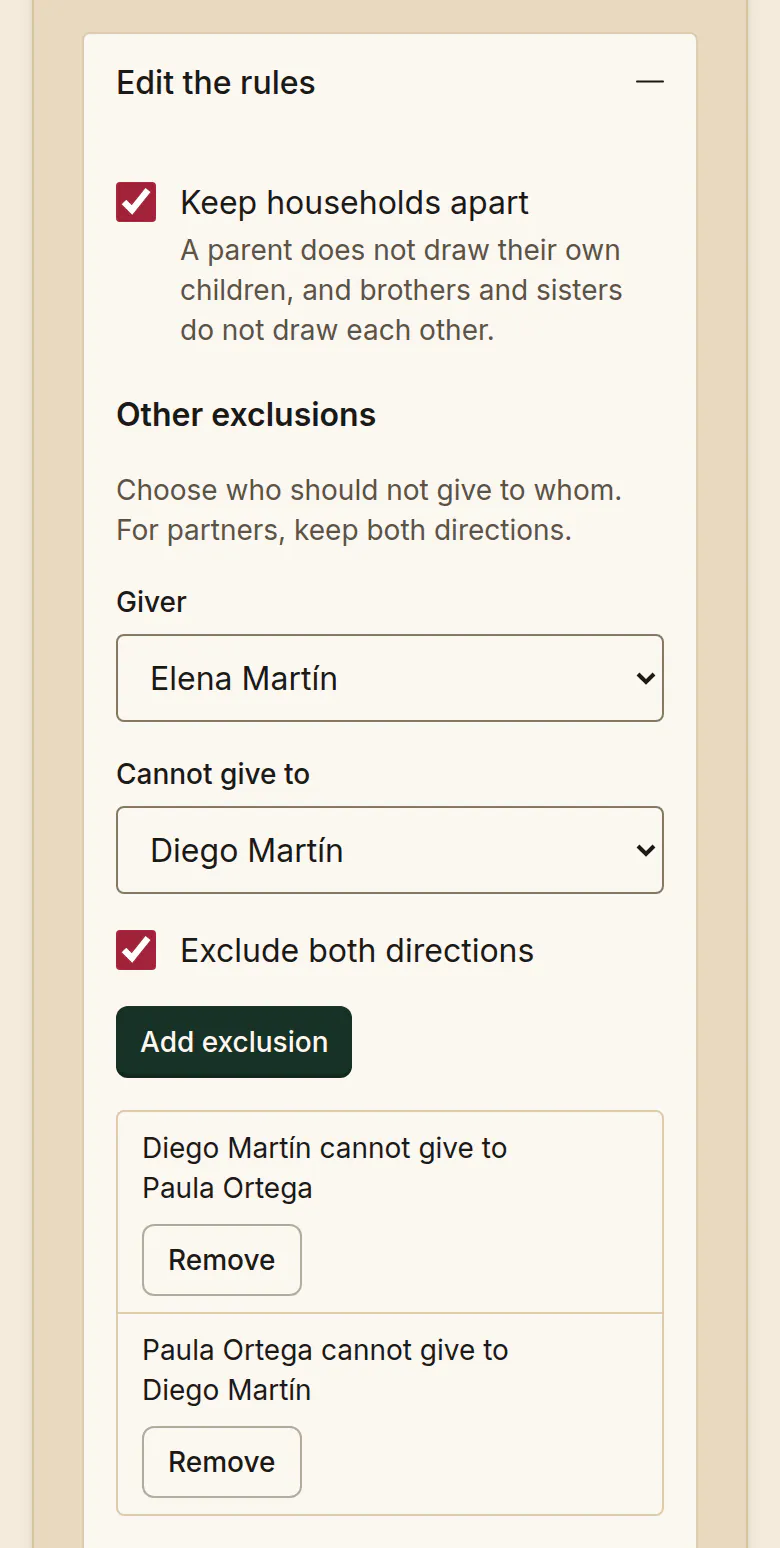
An exclusion says that one participant cannot give to another. If two partners should never draw one another, exclude both directions: Alex cannot give to Sam, and Sam cannot give to Alex. Agree on the rule before drawing rather than changing a disappointing result afterward. In SantaTogether, the organizer sets exclusions inside the exchange, so create the family exchange first and add each pair before the draw.
Parent-managed household exclusions are a separate rule. They cover a responsible adult and their managed children, including siblings managed by that adult. Each adult is their own household, so partners are never covered by this rule: add both pair exclusions if they should not draw each other.
Enough gifts does not guarantee a possible draw
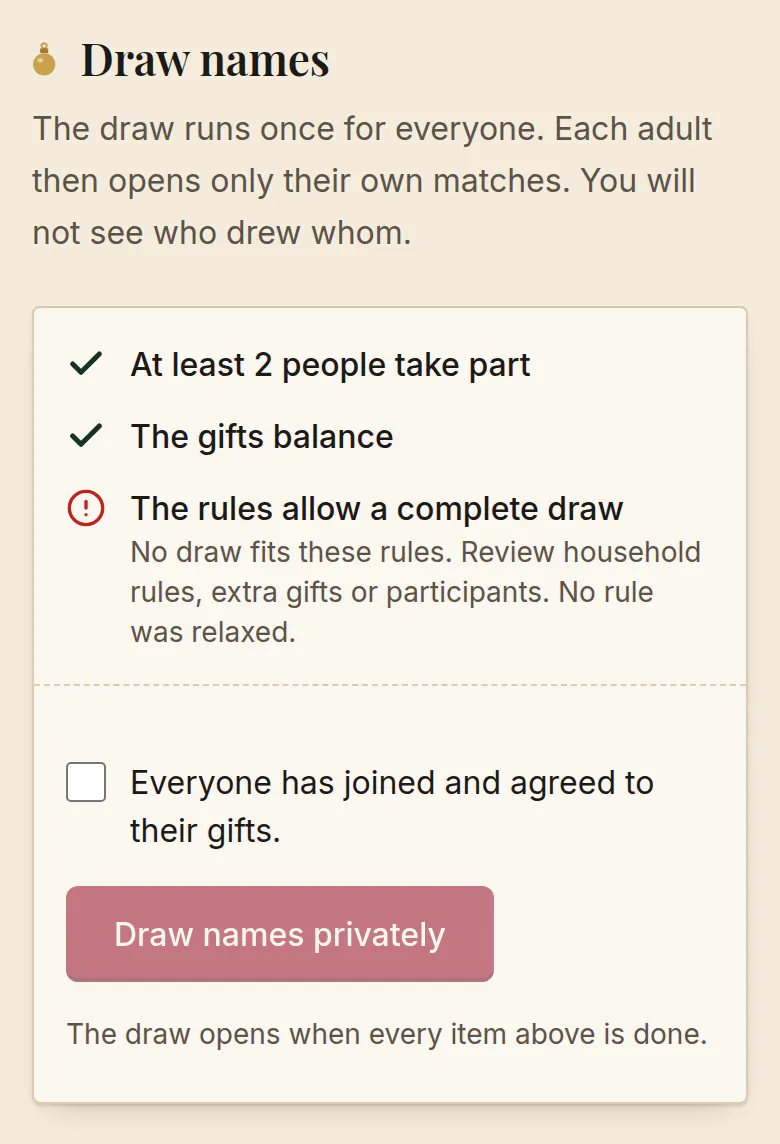
Consider two adults and one receive-only child managed by the first adult. If that parent volunteers for the extra gift but cannot give to themselves or their child, both of their giving slots have only the other adult available. There is no valid result, even though three giving slots cover three recipients.
SantaTogether rejects an impossible configuration without silently ignoring an exclusion. Review who volunteers for the extra slot, change an agreed rule, or include more participants. Repeatedly pressing Draw cannot solve a combination with no valid allocation. Any change must still leave total gifts equal to recipients.
A three-person example, before and after
Alex, Blair and Alex’s receive-only child Robin are the whole group. The managed-household rule stops Alex giving to Robin. Initially Alex volunteers for two gifts and Blair for one. This table shows why the totals balance but the original plan fails.
| Giver | Eligible recipients | Original gifts | Revised gifts, if agreed |
|---|---|---|---|
| Alex | Blair only | 2: impossible with only one eligible recipient | 1 |
| Blair | Alex and Robin | 1 | 2 |
| Robin | No giving obligation | 0 | 0 |
Move a commitment only when the adult agrees
If Blair volunteers for the extra gift instead, Alex can give to Blair and Blair can give to Alex and Robin. All three people receive once and the household rule is respected. This is a change in who pays for an extra gift, so it must be agreed before the draw.
That example leaves only one possible allocation, which everyone could work out. Private results cannot prevent logical deduction. A headcount shortcut such as limiting the largest household to half the group is not a universal test when people have different giving commitments and additional pair exclusions.
What to check when a draw cannot run
Review the roster, then gift totals, then the permitted pairings. Some conflicts involve several people together even if each person has at least one possible recipient. The complete draw must satisfy all rules at once.
| Problem | Check | Next action |
|---|---|---|
| Fewer gifts than recipients | Receive-only children and accepted extra gifts | Ask for volunteers or revise participation before drawing |
| More gifts than recipients | Extra gifts accepted by each adult | Agree which commitments to reduce |
| Totals match but the draw fails | Eligible recipients, household rules and overlapping exclusions | Review commitments and agreed restrictions together |
| Partners remain eligible in one direction | Whether both directed exclusions were added | Set both directions if that is the agreed rule |
| A participant leaves after drawing | Whether the active draw has been cancelled | Pause shopping and review the remaining roster before a redraw |
Keep the rules understandable
Use only exclusions the family actually needs. Every restriction reduces the available choices, and large numbers of restrictions can make the draw predictable or impossible. A short explanation is more useful than a complicated web of private preferences.
Once the draw is published, changing exclusions means resetting the exchange. People may already have seen their match or purchased a gift, so discuss the consequences before the organizer confirms a reset.
Frequently asked questions
- How do I stop a couple drawing each other?
- Add two exclusions, one in each direction: Alex cannot give to Sam, and Sam cannot give to Alex. In SantaTogether, the Exclude both directions option adds both at once.
- Why can the draw fail when the gifts balance?
- Balanced totals are necessary, not sufficient. Every giving slot also needs an eligible recipient once the household rule and all exclusions apply, and all of them must fit at the same time. Review who takes the extra gifts, change an agreed rule or add participants.
- Does the household rule cover partners?
- No. In SantaTogether, a household is one adult and the children that adult manages, so two partners are separate households. Add the partner exclusions explicitly.
Put the plan into practice
Invite the adults, include children through a parent, and agree the gifts before drawing. Core exchanges and wishlists are free.